

Details:
Customer

Beyond motors d.o.o.
Technology Used
- Ansys Fluent
Objective:
To evaluate the cooling effectiveness of liquid flow inside an axial-flux electric motor designed and manufactured by Beyond Motors d.o.o. through performing conjugate heat-transfer CFD simulations to compare three different solid materials for the stator-carrier part of the motor, which features integrated liquid-cooling channels.
Challenge:
The axial-flux motor generates a significant amount of heat within the winding coils, which must be efficiently removed to ensure reliable operation and prevent thermal degradation. The main design challenge was to evaluate the thermal effect of different stator-carrier and winding-insulation materials thermal properties on the temperature distribution in the motor body and its heat-removal capacity.
Solution:
A steady-state 3D conjugate heat-transfer simulation was performed using the supplied 3D CAD (STEP format) geometry. Key elements of the approach included:
- Fine mesh (y⁺ < 3) of 8 inflation layers at all walls in the cooling channels.
- Temperature-dependent properties for the liquid coolant.
- Convective cooling to the ambient at motor’s external walls.
- Comparison of three stator-carrier materials.
- Sensitivity analysis of insulation thermal conductivity.
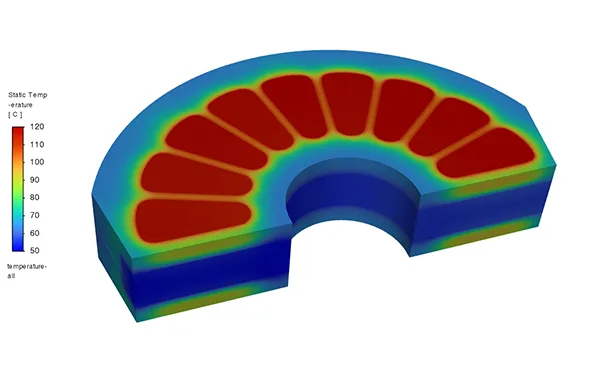
- Results presentation in tables, visualization with temperature contour plots, and delivery in 3D graphics files (opened by the free ANSYS viewer).
This methodology enabled a consistent evaluation of how material choice affects heat removal and temperature distribution.
Conclusion:
Simulation results show that two stator-carrier materials provide excellent thermal performance, with winding temperatures inside the acceptable range and strong heat extraction by the coolant. In contrast, the third material results in dramatically elevated winding temperatures and significantly lower coolant heat absorption, demonstrating that its low thermal conductivity severely limits cooling performance. Convection from external surfaces plays a larger role for the third material but cannot compensate for poor heat conduction.
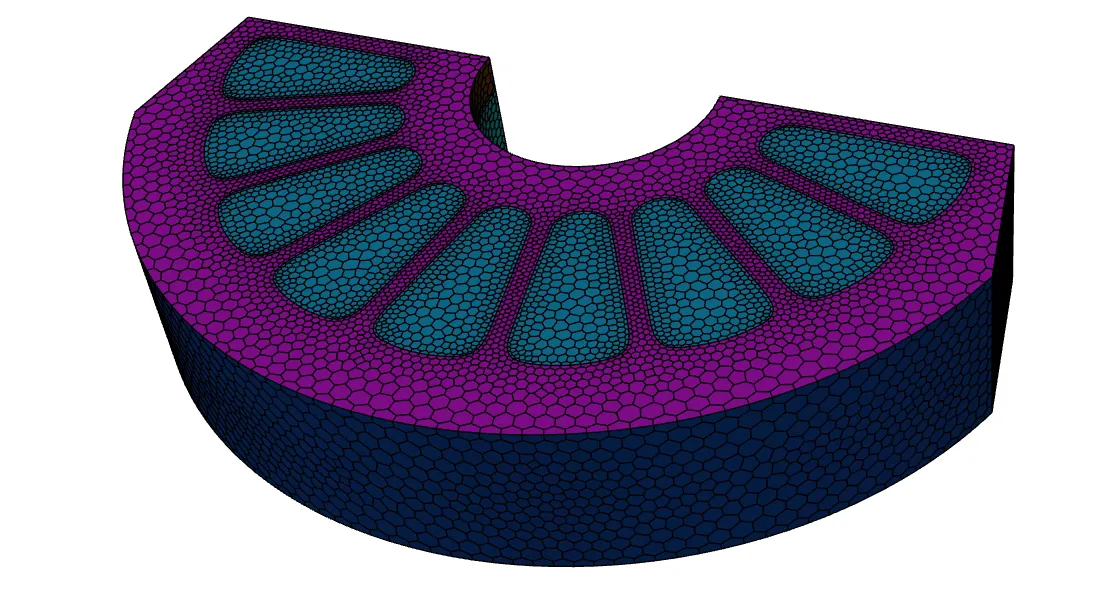
Figure 1: Surface Mesh of the Stator-Carrier Parts of the Axial-Flux Motor in Ansys Fluent (Half Size due to Symmetry).
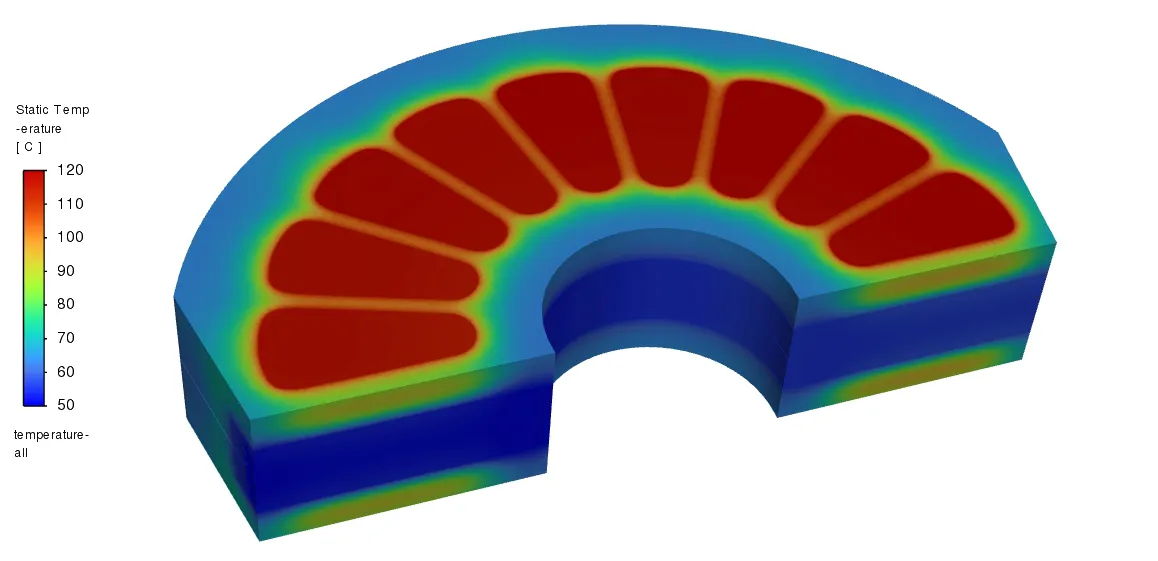
Figure 2: Contours of Temperature [oC] for the Most Thermally Efficient Solid Material Tested for the Stator-Carrier.