

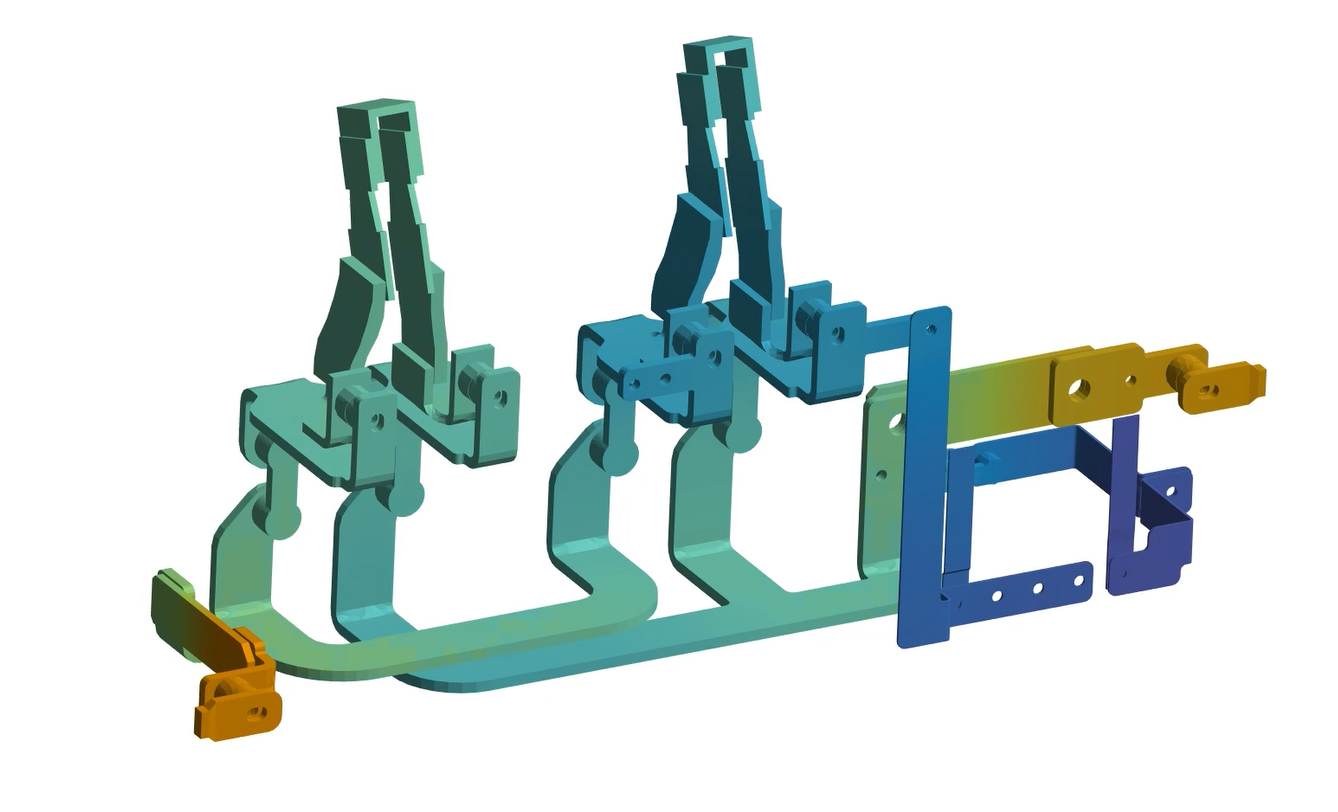
Details:
Technologies Used
- Ansys Mechanical
- Custom Snippets
Objective:
Simulate the electro-thermal behavior of a PDU during a full operating cycle that includes:
- Charging phase with defined current input
- Discharging phase with updated current paths
- Transition between phases through contactor switching
- Temperature-dependent material behavior
Challenge:
Simulating PDUs under alternating operating modes introduces several practical challenges:
- Representation of contactor switching through boundary condition changes
- Different electrical current paths for charging and discharging
- Coupling between current density and Joule heat generation
- Temperature-dependent electrical conductivity and thermal properties
- Maintaining solution continuity across multiple operating phases
Solution:
A multi-step transient electro-thermal workflow was implemented in Ansys Mechanical using the Thermal-Electric Coupled Field analysis type.
The simulation is structured into consecutive phases within a single transient run:
1. Charging phase
- Electric current applied through defined terminals
- Joule heating computed from current density distribution
2. Switching phase (contactor operation)
- Boundary conditions are modified to reflect opening/closing of contactors
- Electrical connectivity and current paths are redefined
3. Discharging phase
- Updated current paths and loads simulate discharge behavior
- Thermal field continues evolving without reset
Key modeling features include:
- Temperature-dependent electrical and thermal properties
- Continuous time integration across all phases
- Accurate computation of current density and volumetric heat generation
- Fully coupled solution of electric potential and temperature fields
This workflow reproduces the real operational sequence observed in physical systems.
Conclusion:
The implemented transient electro-thermal workflow successfully captures the coupled behavior of electrical conduction and heat generation in a PDU during charging and discharging cycles.
The simulation provides the time evolution of temperature, current density, and voltage distribution during both charging and discharging phases.
The results capture the effect of changing electrical paths and operating conditions on thermal behavior, including the development of temperature gradients and localized heating within the PDU.